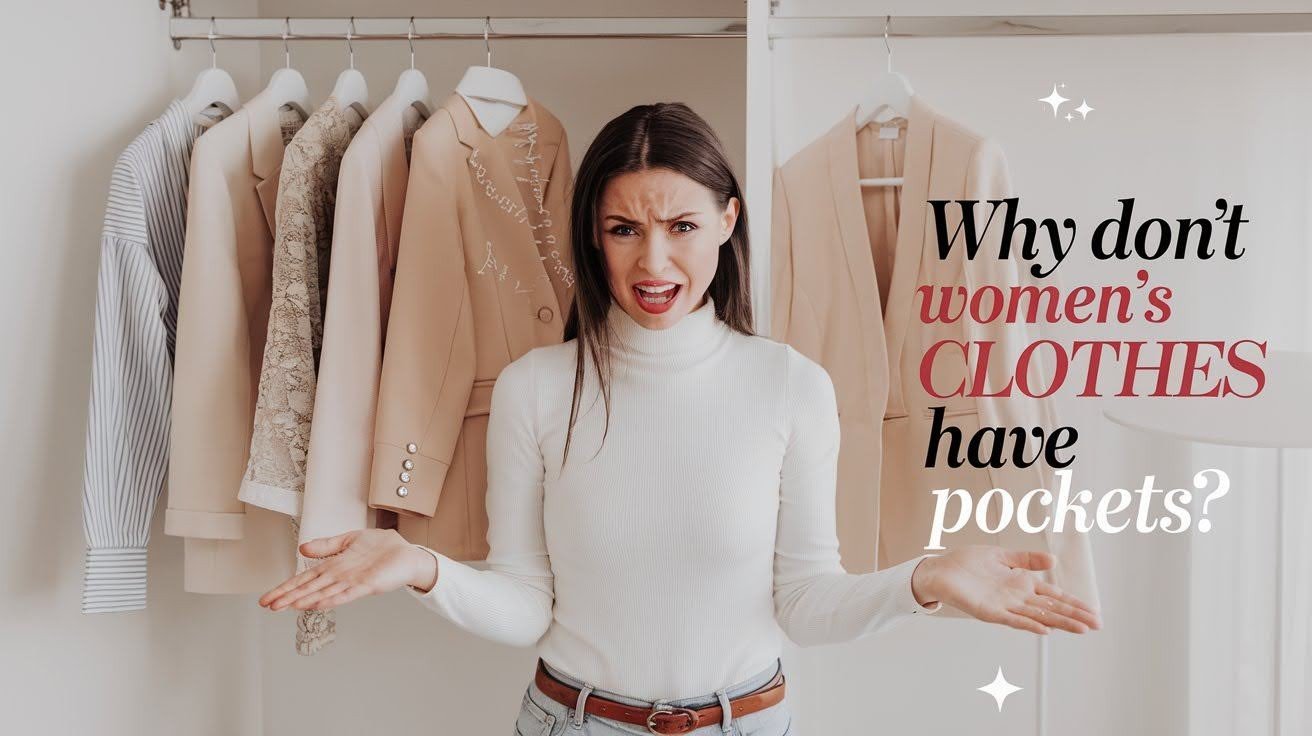
I’ve been there. Standing in a store, trying on jeans that look perfect. Then I reach for the pockets. Fake. You’ve felt this frustration too. Every woman has. You’re not imagining it. Women’s clothes really do have fewer pockets than men’s clothes.
But why?
I spent months researching this question. I talked to fashion historians and dug through centuries of clothing history. What I found surprised me. The missing pocket problem isn’t an accident. It’s about control, money, and old ideas about what women should carry.
In this article, I’ll show you the real reasons behind fashion’s pocket problem. You’ll learn how pockets became political, why handbag companies love fake pockets, and brands fight back.
I’ll give you answers. Ready?
A Brief History of Pockets in Fashion

The Origins of the Pocket
Pockets weren’t always sewn into clothes. Way back in medieval times, both men and women carried small bags tied around their waists under their clothing. These were called “pockets,” from the French word “poque” meaning pouch.
Here’s something interesting: Women actually had more pocket space than men for centuries.
In the 1600s and 1700s, women wore separate pocket bags under their skirts. These pockets were huge. You could fit an entire modern purse inside one. Women stored everything from sewing supplies to snacks to small tools.
Men’s pockets were tiny by comparison.
Women’s Clothing in the 18th-19th Century
Then something changed in the late 1700s. Fashion shifted toward slimmer shapes for women. The French Revolution brought new ideas about freedom, but somehow women’s clothing became more restrictive.
The pocket removal began.
Designers decided that visible pocket bulges ruined the smooth lines of empire waist dresses. Women were told to carry small decorative purses called “reticules” instead.
But here’s what really happened: Society was changing women’s roles. As the Industrial Revolution progressed, men went to work while women were expected to stay home. Men needed pockets for tools, money, and work items. Women supposedly didn’t need much storage because they weren’t going anywhere.
The message was clear: men were active, women were decorative.
20th Century Fashion and Minimalism
The 1900s brought hope. Women started working outside the home during both World Wars. Practical clothing with real pockets made a comeback.
This didn’t last long.
After each war, fashion swung back to emphasizing feminine curves and delicate shapes. Christian Dior’s “New Look” in 1947 cinched waists and eliminated practical pockets. The reasoning? Pockets would ruin the smooth hip line.
Women’s liberation movements of the 1960s and 70s fought back. Pantsuits became popular. Pockets returned to some degree.
But then the 1980s and 90s happened. Minimalism took over. Clean lines were everything. Pockets became the enemy of sleek design.
Gender Politics and Pocket Inequality

Fashion and Power
Let’s talk about what pockets really represent: independence.
When you have pockets, you can carry your own money, keys, phone, and personal items. You don’t need to ask someone to hold your stuff. You’re not tied to a purse that can be forgotten, stolen, or dropped.
Pockets equal freedom.
Fashion historians argue that keeping women’s clothing pocket-free was partly intentional. If women couldn’t easily carry money or important items, they remained somewhat dependent on others.
Think about it. How many times have you asked someone else to carry your phone because your pockets were fake? How often do you feel anxious when you can’t find your purse?
Handbag Business and Consumerism
Here’s where it gets sneaky. The fashion industry discovered something profitable: if women can’t use pockets, they’ll buy handbags.
The global handbag market is worth over $47 billion. That’s a lot of money that depends on your pockets staying useless.
Every fake pocket sells another purse.
Fashion brands have a financial reason to keep your pockets small or nonexistent. Why would they give you free storage when they can sell you expensive bags instead?
Male vs. Female Utility in Clothing
Let’s do a quick comparison:
| Clothing Item | Men’s Pockets | Women’s Pockets |
| Front pants pockets | 2 large, functional | 2 tiny or fake |
| Back pants pockets | 2 functional | Often decorative only |
| Shirt pocket | Usually 1 working | Rare or missing |
| Jacket pockets | 2-4 depending on style | 0-2, often small |
| Total pockets | 7-9 functional minimum | 0-2 barely usable |
This isn’t an accident. It’s planned design discrimination.
The Modern-Day Impact: Style Over Function

Design Problems or Excuses?
Fashion designers love to explain away the pocket problem. They claim pockets ruin the shape, women prefer the smooth look, fabric costs too much, or construction is too complicated.
I disagree.
Men’s clothing proves that pockets and good looks can work together. Well-fitted suits look amazing and have multiple pockets. Athletic wear manages to be sleek while providing storage.
The real issue? Women’s fashion puts appearance over function. You’re expected to look good first, be practical second.
Daily Inconvenience
Living without good pockets affects your entire day. Morning routine: where do you put your phone while getting dressed? Commute: juggling coffee, phone, keys, and transit card without dropping anything. Work: carrying your phone to the bathroom because you have nowhere to put it.
Every day brings dozens of small frustrations that men never experience.
Mental Load
The pocket problem isn’t just annoying. It’s mentally exhausting.
You spend brain power every day managing items that should simply go in your pockets. You make clothing choices based on storage needs rather than personal style. You feel anxious when you can’t find your purse.
This mental load is real. When basic tasks become complicated, it drains your energy for more important decisions.
The Pocket Revolution: Brands and Movements Fighting Back
Better Fashion Brands
Finally, some companies are listening. Brands like Pockets for Women create jeans with phone-sized pockets. Kirrin Finch designs professional wear with working pockets. Wildfang makes clothes that focus on utility alongside style.
These brands understand something important: you want to look good and carry your stuff.
Social Media Changes Everything
The internet gave women a voice about the pocket problem. Hashtags like GiveMePockets and PocketEquality went viral. Women started sharing photos of tiny pockets next to men’s pockets. The size difference was shocking.
TikTok changed everything. Videos showing fake pockets or comparing pocket sizes got millions of views. Suddenly, everyone was talking about this invisible problem.
Celebrity Support
When celebrities like Amy Poehler and Sarah Michelle Gellar spoke out about the pocket problem, mainstream media paid attention.
Fashion magazines that once ignored the issue started writing articles. The conversation shifted from “just deal with it” to “this is actually a problem we should solve.”
Major fashion weeks began featuring collections with prominent, working pockets. Designers finally realized that practicality could also be fashionable.
What Needs to Change: The Future of Fashion Design
Better Design Education
Fashion schools need to teach students about practical design, not just looks. Future designers should learn that good design serves the user’s needs.
More women in leadership positions at fashion companies would help too. When decision-makers understand the daily frustration of fake pockets, change happens faster.
Your Buying Power
You have more influence than you think. Every purchase is a vote for the kind of clothing you want to see.
Here’s how to use your buying power: research brands before purchasing, read reviews that mention pocket function, support companies that focus on practical design, leave feedback when pockets are bad, and share your experiences on social media.
Vote with your wallet. Companies will change when sales depend on it.
New Pocket Ideas
The future of pockets looks promising. Designers are trying hidden pockets that don’t affect shape, modular pocket systems you can add or remove, smart fabric pockets that expand when needed, magnetic closures that keep items secure, and phone-specific pockets designed for modern device sizes.
Technology and creativity are solving problems that “couldn’t be solved” for centuries.
Conclusion
I started this research angry about fake pockets. I’m ending it hopeful. The missing pocket problem runs deeper than bad design. It’s centuries of telling women that looks matter more than function. That your daily needs don’t count.
But you’re changing this story. Every time you choose brands with real pockets, you vote for better fashion. When you share pocket frustrations online, companies listen. Your voice matters. I’ve shown you the history, politics, and business tricks. Now it’s your turn.
Start today. Check your next clothing purchase for working pockets. Support brands that respect your needs. Share this article with friends.
Together, we can end the pocket conspiracy. You deserve clothing that works hard. Your phone belongs in your pocket.
Frequently Asked Questions
Are women’s pockets really smaller than men’s pockets?
Yes, studies show women’s pockets are 48% shorter and 6.5% narrower than men’s pockets on average. Most women’s front pockets can’t even fit a standard smartphone completely.
Why do clothing brands make fake pockets?
Fake pockets cost less to make than real ones and maintain smooth clothing lines. They also encourage handbag sales, which is a multi-billion dollar industry that profits when women can’t carry items in their clothes.
Which clothing brands actually make good pockets for women?
Brands like Pockets for Women, Kirrin Finch, Wildfang, and many athletic wear companies focus on working pockets. Always check reviews and product descriptions before buying to confirm pocket quality.
Did women’s clothing always lack pockets?
No, women had larger pockets than men for centuries. The pocket removal happened gradually from the late 1700s onward as fashion emphasized slimmer shapes and society expected women to be less mobile.
How can I find women’s clothes with real pockets?
Read customer reviews that mention pocket size and function. Search for “working pockets” when shopping online. Support brands that specifically advertise practical design features in their marketing.